
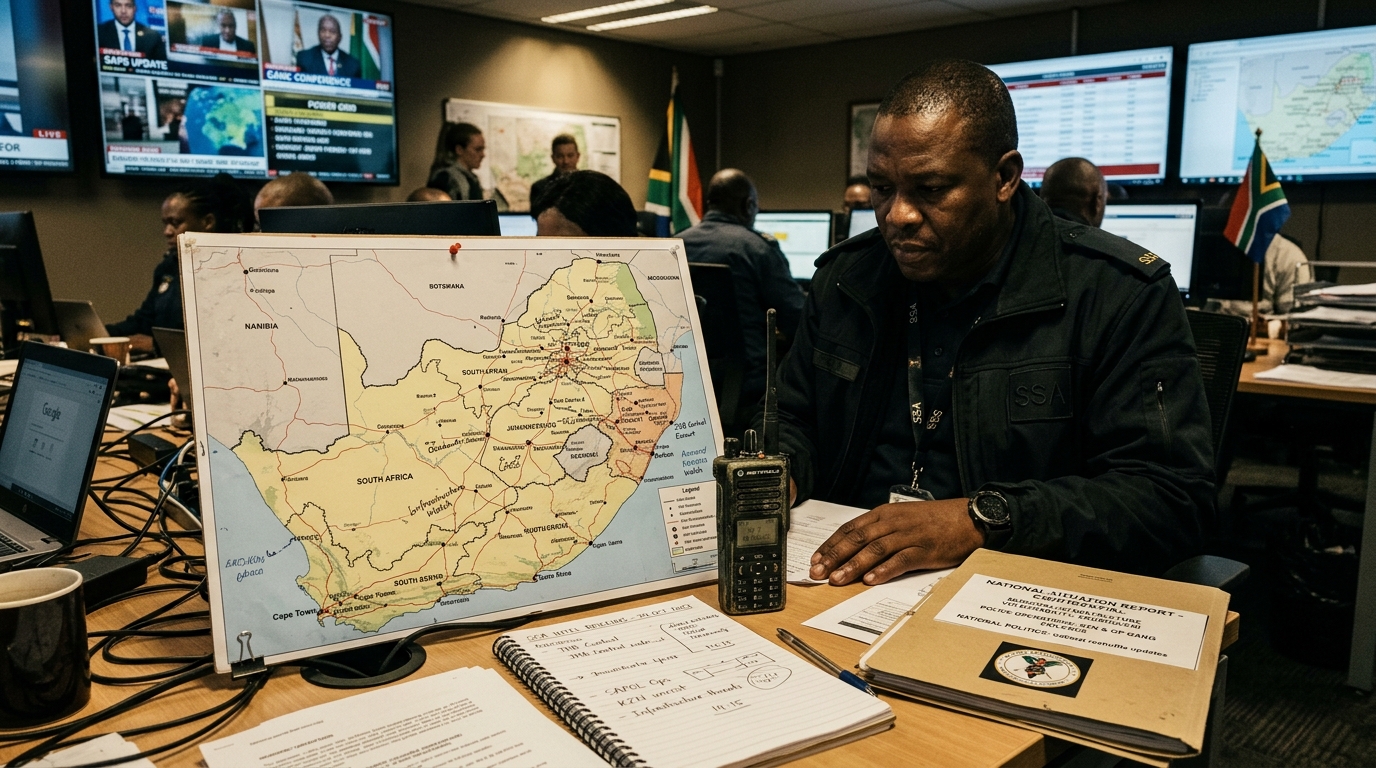
An exhaustive operational intelligence review covering the latest political controversies, high-level cross-border syndicates, rural policing deployments, missing medical personnel, food supply chain vulnerabilities, highway logistics, and strategic geopolitical alignments shaping South Africa today.
1. Ministerial Conduct & Municipal Water Frustration: The Pemmy Majodina 'Jou Ma Se' Controversy [POL-02 / POL-07]
Public accountability and municipal service delivery friction reached a boiling point in the Eastern Cape when Minister of Water and Sanitation Pemmy Majodina was recorded in an explosive confrontation with frustrated residents. During a community engagement meeting in Sterkspruit addressing chronic water outages and failing municipal distribution systems, an exasperated local resident challenged the department's delivery record. In response, Minister Majodina unleashed a vulgar verbal assault, retorting with “Jou ma se...” before walking away from the engagement.
The incident ignited immediate national backlash. Opposition parties, led by the Democratic Alliance (DA), have formally submitted ethics complaints to the Parliamentary Joint Committee on Ethics and Members' Interests, as well as the Public Protector, demanding sanction for gross violations of the Ministerial Executive Ethics Code. Following days of ministerial silence, political spokespersons attempted to downplay the outburst as an uncharacteristic emotional reaction provoked by community heckling.
Operational Takeaway for Households
The Sterkspruit incident is symptomatic of collapsing municipal water governance nationwide. High-ranking officials cannot deliver basic utility services through executive rhetoric or heated town halls. Relying on state infrastructure guarantees vulnerability. Households must accelerate decentralized water independence: borehole extraction, multi-stage rainwater harvesting, and gravity-fed mechanical filtration systems must be prioritized before dry taps trigger localized civil unrest.
2. Cross-Border Crime & Diplomatic Friction: Hawks-INTERPOL Extradition vs. Pretoria-Abuja Warnings [CRI-01 / SAF-01]
Transnational organized crime and escalating diplomatic tension intersected this week along the South Africa–Nigeria corridor. In a major joint operation, the Directorate for Priority Crime Investigation (the Hawks), operating in direct liaison with INTERPOL South Africa and the United States Department of Justice, executed the formal extradition of six Nigerian nationals to the United States.
The six suspects were indicted in federal court for orchestrating a sophisticated \$6.2 million (approx. R110 million) cyber-syndicate specializing in romance scams, business email compromise (BEC), and identity theft schemes that defrauded more than 100 vulnerable victims across North America and Southern Africa. Operating from secure residential enclaves in Gauteng and KwaZulu-Natal, the syndicate utilized shell corporate accounts and local financial infrastructure to launder illicit transfers before conversion to cryptocurrency.
Simultaneously, bilateral diplomatic relations between Pretoria and Abuja suffered severe strain. Prominent Nigerian political figures, including former Minister Femi Fani-Kayode and federal lawmakers, issued sharp warnings condemning what they termed unabated violent attacks and systemic xenophobic profiling targeting Nigerian nationals in South Africa. The rhetoric follows recent moves by the Nigerian parliament to boycott select South African bilateral engagements. While Nigerian authorities focus on diaspora safety, South African law enforcement faces escalating pressure over transnational syndicates exploiting porous border controls, fraudulent visa pipelines, and domestic cyber infrastructure.
Operational Takeaway for Cybersecurity & Community Relations
The scale of the \$6.2M bust highlights the relentless sophistication of domestic cyber fraud rings. Individuals and business owners must mandate multi-factor biometric authentication, enforce dual-signoff protocols on electronic bank transfers, and remain vigilant against social engineering romance hooks. Furthermore, rising xenophobic rhetoric poses immediate risks to retail supply chains and foreigner-dense business zones during civil flashpoints.
3. Rural Border & River Corridor Policing: SAPS Interventions in Viljoensdrift [CRI-02]
The South African Police Service (SAPS) launched coordinated rural safety and high-visibility stabilization operations in the Viljoensdrift policing precinct within the Fezile Dabi District of the northern Free State. Located along the critical Vaal River boundary separating the Free State from industrial southern Gauteng, Viljoensdrift constitutes a strategic and vulnerable rural corridor.
The precinct has been plagued by illicit river-crossing smuggling routes, organized stock theft syndicates, armed farm trespass, and systematic cable theft targeting Transnet freight rail links and municipal water pump stations. SAPS rural safety units, supported by aerial surveillance and local agricultural security clusters, executed vehicle checkpoints, cordon-and-search actions, and compliance audits on local scrap metal yards.
Rural Security & Perimeter Hardening
Border and riverfront properties present asymmetric security vulnerabilities due to natural extraction routes for criminal gangs. Rural landowners must maintain integrated radio links with local Community Policing Forums (CPFs) and Agri-Security cells. Early-warning trip-line beams, thermal perimeter cameras, and cleared visual buffer zones along riverbanks are essential components of farm defense.
4. Targeting Medical Personnel: The Alarming Search for Mokopane Hospital's Missing Doctor [CRI-03]
An urgent missing persons investigation and tactical search operation was mounted by the SAPS in Limpopo following the unexplained disappearance of a senior medical practitioner attached to Mokopane Hospital. The doctor vanished after completing duties, prompting widespread distress across the regional medical community and triggering high-level alerts across provincial transit nodes.
The incident spotlights an escalating and disturbing trend across South Africa: the deliberate targeting of essential medical practitioners, healthcare specialists, and emergency personnel for kidnapping, ransom extortion, and opportunistic carjacking. Medical personnel frequently commute during irregular overnight hours, navigate poorly illuminated hospital access roads, and are perceived by criminal syndicates as high-net-worth individuals.
Situational Protocols for Essential Shift Workers
Professional shift workers must abandon predictable travel routines. Crucial safety protocols include: implementing automated live-location check-in alerts with family or security networks upon departing facility gates; verifying vehicle functionality and fuel levels before nightfall; and immediately steering toward the nearest 24-hour manned police station or private security compound if followed by unmarked vehicles flashing imitation emergency lights.
5. Food Security & Agricultural Supply Chains: Combating Counterfeit Seed Infiltration [INF-04 / INF-06]
Regional food production systems and commercial crop security are facing acute threats from the illicit trade in counterfeit agricultural inputs. In East and Southern Africa, regulatory authorities—highlighted by Tanzanian Agricultural Minister Daniel Chongolo's sweeping directives—have initiated aggressive enforcement crackdowns against black-market distribution syndicates selling fake, chemically dyed seed varieties and adulterated fertilizers.
For South African commercial farmers and smallholders, input integrity is an existential operational factor. Counterfeit hybrid seeds fail to germinate or produce sterile, low-yield crops incapable of resisting drought or regional pests like the fall armyworm. When combined with South Africa's fragile logistics grid, escalating fuel tariffs, and unpredictable rainfall cycles, the infiltration of fraudulent agricultural supplies directly threatens domestic grain yields, animal feed supplies, and staple food price inflation.
Securing Household & Farm Seed Banks
Modern industrial hybrid seed reliance leaves food producers completely dependent on complex commercial supply lines. Sustainable resilience requires preserving certified, open-pollinated heirloom seed varieties that can be harvested, dried, and replanted year after year. Store heirloom seeds in hermetically sealed glass mason jars with desiccant packs at sub-15°C temperatures to safeguard food independence against corporate or illicit supply interruptions.
6. Provincial Transit Corridors: Clearance and Lessons from the R521 Polokwane-Dendron Route [SAF-02]
The Limpopo Department of Transport and Community Safety confirmed the full clearance and reopening of the strategic R521 provincial route between Polokwane and Dendron (Mogwadi), near the community of Rita. The corridor had been severely obstructed by road blockades, posing significant hazards to heavy commercial haulage, agricultural transport, and daily commuter traffic.
The R521 serves as a vital economic link connecting Polokwane's central logistics hubs to the northern agricultural border regions and cross-border transport toward Botswana and Zimbabwe. Abrupt arterial closures in rural and peri-urban South Africa leave heavy transport operators and private motorists acutely exposed to secondary collisions, opportunist stone-throwing, or armed hijacking while stranded in stationary queues.
Long-Distance Highway Survival Rules
Never embark on provincial trunk routes without contingency planning. Always maintain a minimum half-tank fuel reserve, download offline topographical and alternative farm-road maps (e.g., Organic Maps or OsmAnd), and carry a dedicated vehicular grab-bag stocked with emergency drinking water, trauma tourniquets, high-visibility reflective gear, and a high-output LED tactical flashlight.
7. Heavy Transport & Workplace Hazards: Emergency Trauma Protocols from Pretoria East [SAF-03]
A severe occupational emergency occurred in Pretoria East when a male logistics worker plummeted approximately three metres from the elevated cargo bed of a commercial heavy vehicle, sustaining traumatic head and spinal injuries accompanied by an altered level of consciousness. Emergency medical responders and advanced life support paramedics conducted rapid on-scene stabilization and immobilization before transferring the patient to an intensive care trauma unit.
This incident is a stark reminder that physical trauma and mechanical hazards frequently occur in daily industrial and logistics environments. In South African distribution depots, farms, and off-grid homesteads, working at height—whether loading freight trucks, servicing solar arrays, or inspecting water storage tanks—carries life-threatening risks where a momentary loss of footing leads to catastrophic head trauma, internal hemorrhage, or paralysis.
Trauma First-Aid Readiness
Industrial safety is survival safety. Every workshop, rural home, and transport vehicle must be equipped with an ANSI-compliant fall-arrest harness and a serious medical trauma kit (including cervical collars, SAM splints, pressure bandages, and CAT tourniquets). Knowing how to maintain an open airway while preventing cervical spine movement during a traumatic fall is the difference between survival and permanent disability.
8. Digital Open-Source Intelligence: Regional African Infrastructure vs. Online Noise [VID-01 / VID-07]
The contemporary information landscape presents severe challenges for real-world risk assessment. Across digital broadcasting channels, high-stakes geopolitical developments—such as Kenyan President William Ruto's extensive national development tours focused on critical infrastructure, port expansions, and East African Community trade logistics—stand in direct contrast to algorithmic entertainment feeds and viral gaming streams (such as Zenless Zone Zero) that saturate digital platforms.
For strategic analysts and self-reliant citizens, separating signal from noise is paramount. Regional African infrastructure shifts, pipeline treaties, cross-border port corridors, and energy grid developments dictate economic trade balances, currency valuations, and regional stability. Meanwhile, social media algorithms actively prioritize commercial gaming content and pop-culture trends, distracting audiences from pressing supply chain and geopolitical realities.
Information Curation for Risk Readiness
Information hygiene is a survival discipline. Filter out algorithmically induced consumer noise. Rely on primary open-source intelligence (OSINT), official government gazettes, vetted dispatch networks, and shortwave/two-way radio channels to monitor genuine macro-economic and physical security conditions.
9. Pretoria's Global Multilateral Chessboard: Backing India for a Permanent UN Security Council Seat [HOT-02]
South Africa's foreign policy positioning took center stage on the international diplomatic front as Minister of International Relations and Cooperation Ronald Lamola explicitly reaffirmed Pretoria's endorsement of India's bid for a permanent seat on the United Nations Security Council (UNSC). Speaking in bilateral forums and BRICS diplomatic panels, South African officials argued that the current post-WWII multilateral architecture is fundamentally obsolete and fails to reflect Global South demographics and economic weight.
This endorsement reinforces Pretoria's strategic alignment with the expanded BRICS+ bloc (Brazil, Russia, India, China, South Africa, Egypt, Ethiopia, Iran, and UAE) while seeking to balance trade treaties like AGOA with the United States and the European Union. While foreign policy posturing elevates South Africa's diplomatic voice abroad, international alignments carry tangible domestic economic ramifications, influencing bilateral investment streams, secondary sanction risks, and national currency volatility.
Financial Diversification in a Fracturing Global Order
Geopolitical realignment signals increasing volatility for fiat currencies, export tariffs, and international supply chains. Domestic households must hedge against Rand depreciation and international trade friction by diversifying assets into hard tangible commodities: physical precious metals, productive arable land, off-grid utilities, and practical self-sufficiency skills.
10. National Resilience & System Redundancy: Strategic Lessons from the Springboks' Rivalry Triumph [HOT-04]
In a thrilling sporting exhibition with profound cultural and strategic resonance, the South African Springboks clinched a historic series victory over the New Zealand All Blacks. Driven by head coach Rassie Erasmus's innovative “Bomb Squad” forward bench deployment, the Springboks dismantled late-game opposition through overwhelming tactical discipline, superior physical conditioning, and structured squad redundancy.
Beyond providing an immense morale boost to a South African population frequently beleaguered by governance failures, infrastructure breakdowns, and economic pressure, Erasmus's rugby doctrine provides a masterclass in operational doctrine. The core premise of the “Bomb Squad” is that no single superstar can endure a sustained crisis; victory requires deep, seamless operational redundancy where backup personnel perform with equal or superior intensity to front-line operators.
The Prepper's 'Bomb Squad' Principle: Redundancy is Survival
In survival doctrine: One is none, two is one. The Springboks' tactical model should be mirrored in every household contingency plan. Do not rely on a single water pump, a single solar inverter, or a single vehicle. Ensure your critical life-support systems have tested secondary and tertiary redundancies—your own “Bomb Squad” ready to engage instantly when primary infrastructure fails.
Compiled by the Surviving South Africa Editorial & Intelligence Desk from primary SAPS communications, Department of Transport bulletins, international legal dockets, and verified open-source feeds.
